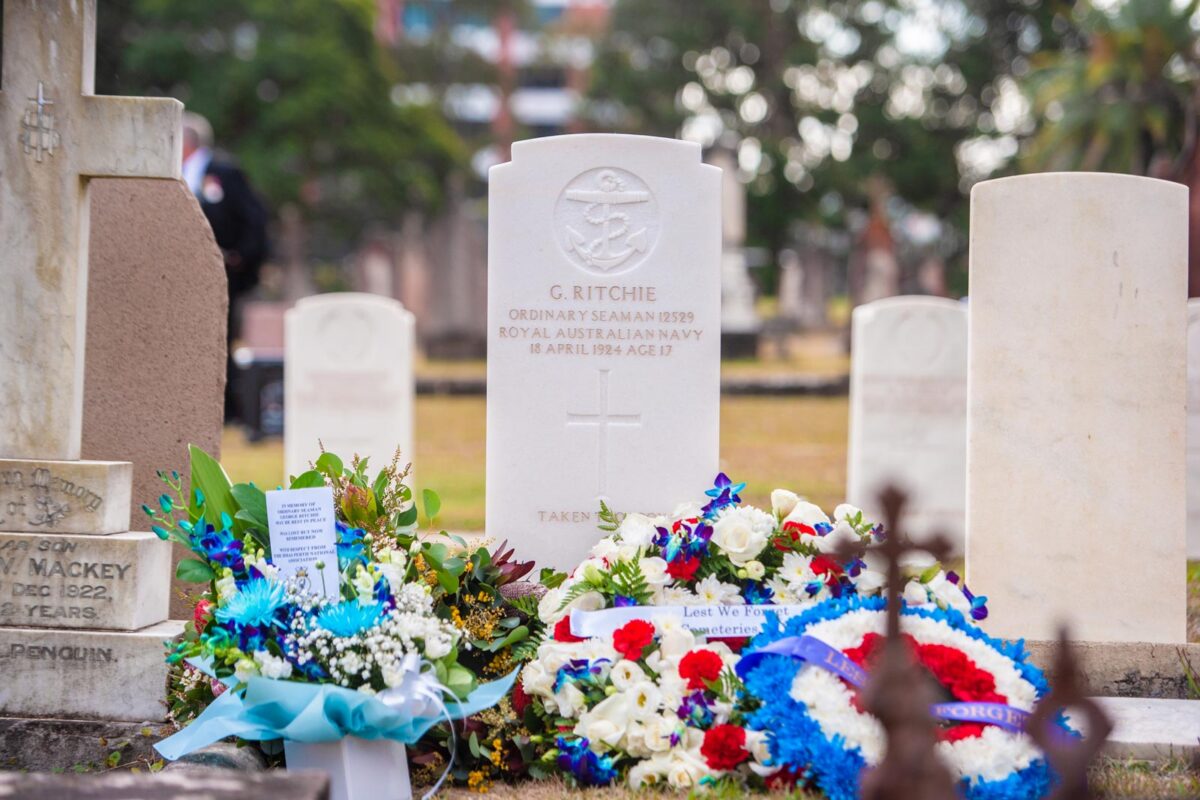
Dedication service for the headstone of Ordinary Seaman George Ritchie

An excerpt from speech by Mark Fleming, given at Rookwood Cemetery.
Ordinary Seaman George Ritchie was buried here with full naval honours some 98 years ago. He has lain for all that time, unmarked and largely forgotten by all but family and the Naval Graves Project. Today we gather, to in a very real way, to give George his name back, so that from this day forward his name is displayed for all to see that here, in this grave, rests George Ritchie a sailor of the Royal Australian Navy.
George Ritchie’s story stood out from among stories of the other unmarked men, he did not die of illness, in an accident ashore or at his own hand, he was murdered onboard his ship. We felt this made his case different to the others and we decided to do something about it. The campaign to get a headstone for George lasted approximately one month, George’s age and sad fate touched many hearts. I need to tell you, that two members of the NGP were so touched by George’s story they offered to purchase a stone for him, because “if he was our boy we would want him to have a headstone” however other sources too were touched and in an act of grace the headstone we dedicate today was provided.
George was born on Tuesday July 17th, 1906 in Melton, Victoria. He was the first of six children born to Annie Cecilia Quinane and David Murray Ritchie between 1906 and 1917. Annie was to die on 20 June 1922 shortly before George joined the Navy on 19 Jul. How hard it must have been for him to lose his mother and then leave the family home in such a short time.
George was a Tingira Boy, that is a term used for the Navy’s boy seaman, those who joined before 18 years of age. HMAS Tingira was the ex Clipper Ship Sobroan, formerly a NSW Government boys industrial training ship. In 1911 the Sobroan was purchased by the Commonwealth Government and taken in hand for conversion to a boys training ship. As a vessel of the RAN she was moored in Rose Bay, training of all Boy Seaman took place onboard her from 1912 to 1927. The boys had to be between 14 ½ and 16 years on joining and were to serve a return of service of seven years commencing from their 18th birthday.
George was one of 3,158 boys who were trained in Tingira and one of five Tingira Boys buried in the Catholic Naval Section, George Page grave 9,
Michael Mackey who rests next to George in grave 11
Kevin Young grave 14,
and Emile Mason grave 18
George joined Tingira on 19 Jul 1922 when he was 16 and was rated as a Boy Seaman Class 2 and after some training was rated as a Boy Seaman Class in Jun 1923. He made the rating of Ordinary Seaman Class 2 on the July 1923 when he turned 17. On 3 Oct that year he joined the Light Cruiser HMAS Brisbane (I) and on the 17 Jan 1924 was rated as an Ordinary Seaman. Sadly, the Brisbane was to be his first and last warship. In the early morning hours of 18 April 1924, he was murdered while in his hammock, his throat was cut and he suffered a severe blow to the head. He was officially declared dead by Surgeon Lieutenant Thomas Kidston, medical guard officer of HMAS Penguin. George was only 17 years 9 months old.
The order to ‘clear lower deck” was given, and the crew mustered, it was found that one of the ships company, a Cook, George Brown was missing. The ship was searched, and the body of George Brown was found hanging in the refrigeration room. The Sydney Water Police took over the investigation resulting in a Coronial Inquiry held upon the ship on the 2nd and 5th of May 1924, where the Coroner Mr Jamieson found that “George Ritchie was murdered by George Brown who later committed suicide”. He then decided to comment of matters outside of his experience saying that he believed that naval discipline was too rigid and that the crew felt “it would not be wise to report to any officer a matter they would not be able to substantiate”. He made these statements based on the rumours and tales that sprang up around George’s murder and regardless of having had the divisional system explained to him. In the Navy the divisional system is in place to ensure that the concerns and welfare of its people are addressed, it has been my experience, it works.
The Coroner’s misunderstanding of naval discipline did not help the situation, the Press wasted little time reporting this. At first the Navy had been content to accept the civilian investigation, however the Coroner’s statement and the reaction in the press prompted the Naval Board, against the advice of serving officers to proceed with its own Inquiry. The Naval Court of Inquiry found that the evidence against George Brown was circumstantial, and no motive was apparent, the Officers of the Inquiry found that “Ordinary Seaman George Ritchie met his death at the hands of someone unknown” but they went on to state Cook Brown “is indicated strongly as having been the murderer”. The Court’s finding was based on the facts and not the “buzzes” or stories that surround any major incident. The simple truth is we do not know who killed George, we can suspect or reason, but we do not know. The records of the Court of Inquiry are available as a free download from the Australian National Archives.
Newspapers report that both George Ritchie and Brown were buried at Rookwood on Saturday the 19 April 1924. George Brown in the RAN Cemetery in Anglican section four and George Ritchie here in the Catholic Naval section. The Daily Telegraph of Mon 21 April 1924 reported that “14 seaman of the ship (HMAS Brisbane), all young Australians attended”, it went on to report “half of their number constituted a firing party and carried reversed arms”. The Brisbane Telegraph reported that “about 200 civilians witnessed the service, including many women” The service was carried out by the
Brisbane’s Catholic Chaplain Farther Adrian Martin assisted by a Father Clancy. Both reports stated George Brown was buried at Rookwood the same day, “there were few to witness his burial” is all that was reported. George Brown, guilty or not, is not forgotten by the Naval Graves Project.
Neither George Ritchie nor George Brown received a headstone. This was due to Policy at the time which stated that those not killed in the line of duty would not receive a headstone at Government expense, but one could be provided by the ships own funds. This was no new policy, Navy was following an old policy, handed down from the Royal Navy. I draw your attention to several headstones here that have “erected by” inscribed upon them, these headstones were provided by private funds, either the family and or by a collection among the ships company of the sailor’s ship. Such headstones are present within all three Naval sections in Rookwood.
In later years this policy has been difficult to understand as it was inconsistently applied. Within this section, there rest men who have lost their lives in off duty Motor Vehicle Accidents who have had naval burials and headstones provided, one such sailor is 17 year old SMNQMG Bradley Thomas Wine, of HMAS Brisbane (II) who was killed in a motor vehicle accident in Suva, Fiji, Jul 1985. Yet in the official RAN cemetery in Rookwood, there rest others unmarked who were lost to us in MVA’s. I ask you to stop for a moment to think of how small a world it is …two sailors both 17 from ships called the Brisbane lay just meters and 61 years apart.