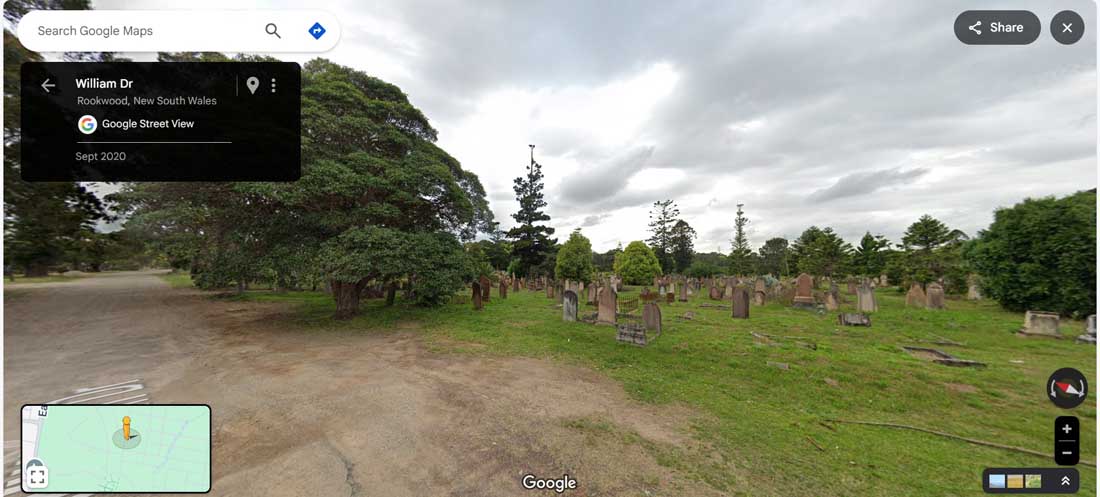
Just to the east of a modern bus stop, William Drive leaves Necropolis Circuit within the original portion of Rookwood Cemetery and runs north to the boundary at Railway Street. To the left (west) of this modest sealed road one comes across manicured lawns and uniform rows of white headstones of an order of Catholic priests or religious before one encounters the “marble city” of later communities of southern European migrants. To the right (east) is the more unkempt, if more interesting flora of the first sections of the original Church of England (Anglican) grant.
William Drive is the hard boundary of religious divisions perpetuated even in death between Anglicans and Catholics in mid-19th century Sydney (the smaller Protestant and Jewish communities having burial privileges further south). For Naval Graves Project personnel, William Drive is the familiar route to the unofficial “Catholic Naval” section (M1-TT). Now, NGP members will know that they pass another naval grave to get to section TT.
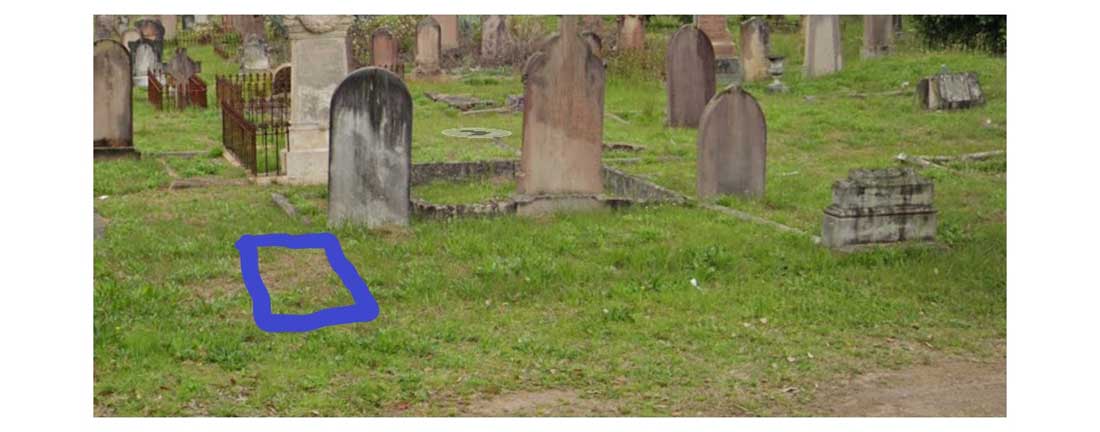
As the sealed section of William Drive gives way to the unsealed section, to your right you will notice a small cluster of older headstones (see photo 1). To the left of the cluster and the row closer to William Drive is an unmarked grave (see photo 2) – that of Warrant Officer’s Servant Thomas Pearcy of HMS Basilisk. The official location is Zone B, Section D, Grave 20.
Thomas was 19 when he died in Sydney Infirmary on 29 October 1872 of phthisis pulmonalis (pulmonary consumption). He was buried the next day without fanfare or naval honours. Indeed, his death certificate does not even record that his burial was conducted by a clergyman! Thomas had reported sick to the Medical Officer onboard HMAS Basilisk on June 6th. His condition never improved and, when Basilisk’s tour of the Polynesian islands of the south sea (in areas now commonly associated with the Solomon Islands) finished with arrival in Sydney on 24 September, he was rapidly removed to the hospital. Even if he had recovered, his naval career was over and the plan was to send him home to England. It is surprising that no one from the ship was involved after death as Basilisk was still in port. Perhaps Warrant Officer’s servants did not rate as “official RN” as my attempts to locate a service record have proved fruitless. Without referral to the ship records, the manager of the Infirmary had little to report so there are no details of where he was born or who his parents were.
And so he has rested, unseen and forgotten – until now.